What communities migrate away from
An importer is somebody's weekend spent building an escape route. Count them and you have a map of where communities have needed one.
Migration tooling is written for a reason. Nobody builds an importer speculatively; somebody had content in one place, wanted it in another, and the job was big enough to justify code rather than copy and paste. Every importer that exists is a small piece of evidence about where communities have been and where they went.
Discourse keeps its importers as ordinary files in its repository — one per source — which makes that evidence countable rather than anecdotal. On 2026-09-02 the directory held 63 scripts, 59 of which name a recognisable source. Sorted by what kind of thing each source is, they look like this.
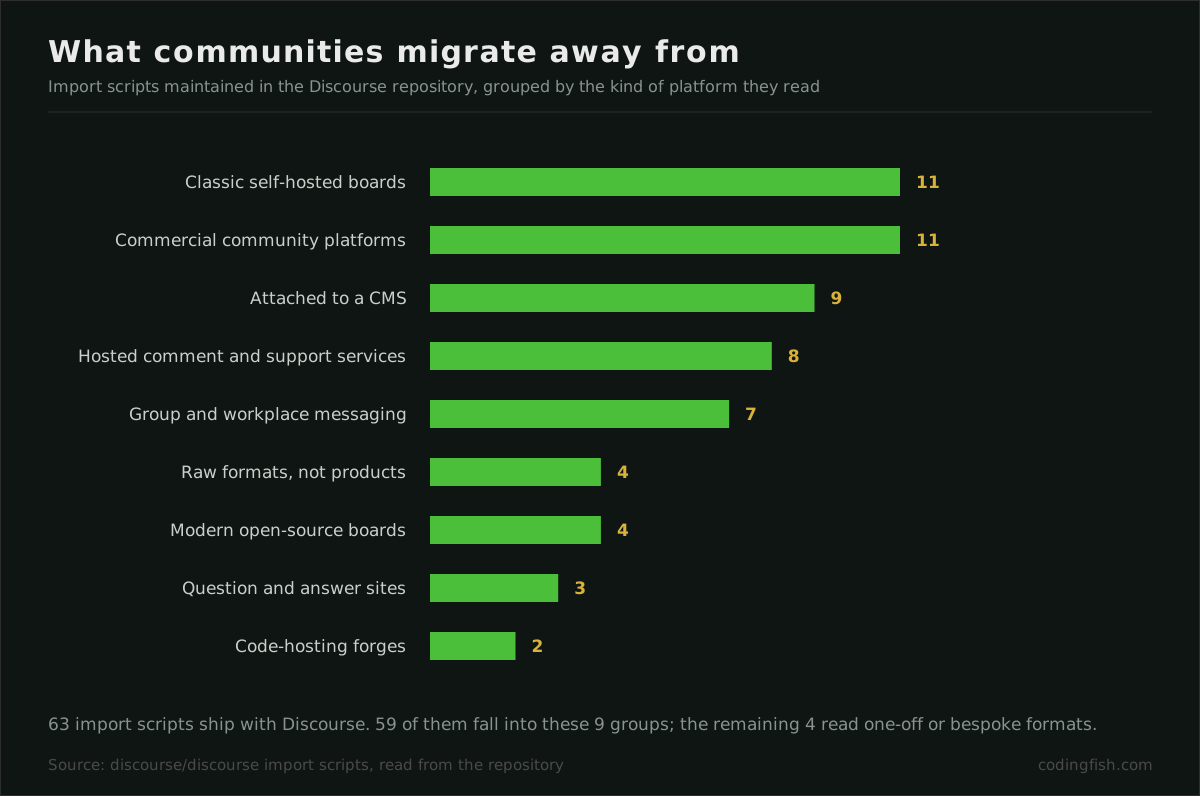
Sources with an importer, by kind
Read from the project's own importer directory on 2026-09-02.
| Kind | Count | Named sources |
|---|---|---|
| Classic self-hosted boards | 11 | phpBB, MyBB, MyBB (ru), Simple Machines 1, Simple Machines 2, PunBB, FluxBB, Phorum, JForum, my little forum, Simple:Press |
| Commercial community platforms | 11 | vBulletin, vBulletin 3, vBulletin 5, XenForo, Invision Power Board, Invision Power Board 3, Jive, Jive (API), Lithium, Telligent, Higher Logic |
| Hosted comment and support services | 8 | Disqus, Muut, Get Satisfaction, Zendesk, Zendesk (API), Answerbase, AnswerHub, Zoho |
| Group and workplace messaging | 7 | Google Groups, Yahoo Groups, Ning, Slack, Yammer, Elgg, Friends+Me (Google+) |
| Attached to a CMS | 9 | bbPress, Kunena, Kunena 3, Drupal, Drupal 6, Drupal (JSON), Drupal Q&A, MODX, Discuz! X |
| Question and answer sites | 3 | Askbot, Question2Answer, Stack Overflow |
| Code-hosting forges | 2 | SourceForge, FusionForge |
| Raw formats, not products | 4 | mbox mail archives, a CSV file, a generic JSON dump, Nabble |
| Modern open-source boards | 4 | Flarum, Vanilla, Vanilla (MySQL), Vanilla (body parser) |
Why an importer is better evidence than a survey
Ask people which platform they left and you get recollection, sampling bias and whoever happened to answer. Count importers and you get something narrower but harder: for each of these sources, a specific person read two schemas, wrote code, and kept it working long enough to be merged.
The cost is that it undercounts badly. Migrations that happened by hand, by consultant, or by a script nobody published leave no trace here at all, and small platforms rarely justify the work however many people leave them. So the list is a floor, not a census — every entry is real, and the absences prove nothing.
What this list is not
It is not a list of dead software, and it would be a more dramatic page if it were. An importer exists because somebody left, not because the place they left stopped existing. Several sources here are actively developed and doing well; some changed hands or names; some genuinely are gone. The directory listing does not distinguish between those, so neither does this page.
It is also one project's view. Discourse writes importers for the platforms whose users it expects to receive, which is a commercial as well as a technical decision. A source's absence means nobody prioritised it, not that nobody ever left it.
The two biggest groups are the same size
Classic self-hosted boards and commercial community platforms are tied. That is the first thing in the data that contradicts the usual story, which is that people move from free software to paid as they grow.
Both directions are equally well served here. There is an importer from phpBB and one from vBulletin; from Simple Machines and from Invision Power Board. Whatever pull the paid tier has when a board is growing, the return journey is well enough travelled that somebody maintained the code for it.
The commercial group has a second characteristic worth noticing: several of its members are enterprise community products rather than hobby forum software — Jive, Lithium, Telligent, Higher Logic. Those are bought by companies, not by hobby communities, which means somebody moved a corporate community onto open-source software and needed the content to come with it.
The hosted services tell a different story
Eight sources are hosted comment or support products, and one thing separates them from everything else on the list: nobody self-hosting them had a database to export. Leaving means asking an API for your own content and hoping the answer is complete.
That is why these importers exist in the shape they do — several talk to an API rather than reading a dump, and two of them exist twice, once for each method. It is also the strongest practical argument in the whole dataset. Software you run leaves a directory and a database behind when you stop; software you rent leaves whatever the export endpoint chooses to give you.
Mailing lists are still arriving
Among the sources are formats rather than products: mbox mail archives, a CSV file, a generic JSON dump. The mbox importer is the interesting one.
An mbox file is a mail spool — the format mailing lists have used since long before forum software existed. An importer for it means communities are still moving decades of list traffic into a modern board, and that somebody considered those archives worth carrying. Two more entries in the group category are Google Groups and Yahoo Groups, which is the same movement one layer up: conversations that lived in email, being given an address.
If your own community has an archive like that sitting in a mailbox, it is more portable than it looks. That is the practical takeaway hiding in a directory listing.
Nine sources are not forums at all
They are forums attached to something else — a plugin on a content management system. bbPress on WordPress, Kunena on Joomla, the Drupal modules, Simple:Press.
Those are chosen because the site already runs that system and the forum can be added in an afternoon. What the importers suggest is what happens next: the discussion outgrows being a plugin, and the community moves to software whose whole job is the conversation. That is a reasonable path, and it is worth knowing at the start that it is a common one.
Duplicate scripts mark the hard sources
Several sources appear more than once — Simple Machines has one importer per major version, vBulletin has three, Invision two, Kunena two, Vanilla three, Zendesk and Jive one each for the database and the API.
That repetition is the most informative pattern in the directory, because it is unpaid work done twice. A single importer means one schema somebody understood. Three means the source changed underneath in ways that broke the previous reader, and somebody cared enough to write it again.
Read as a warning it is useful: a platform whose major versions each need their own importer is one whose own upgrades were substantial enough to move the furniture. That is not a criticism — long-lived software earns the right to change — but it is worth knowing if you expect to sit on one installation for a decade.
Vanilla is the interesting variant: its three scripts are not versions but methods, one of them dedicated to parsing post bodies. When markup needs its own file, the markup was the hard part, and that is the piece of a migration people underestimate most.
What is missing is also informative
There is no importer for several platforms in this site's own catalogue — the newer open-source boards, the marketplace software, the chat servers. Their absence is easy to over-read, so here is the careful version.
A missing importer means no one has yet needed one badly enough, which for recent software usually means its users have not been running it long enough to leave. It says nothing about quality and it will change. When a platform has been in production for a decade, somebody eventually writes the exit.
The chat servers are a genuinely different case. Their absence reflects shape rather than age: a scrolling channel does not import into a threaded board in any way that preserves what it was, which is the same argument the picker makes when it asks what the conversation should do before it asks anything about software.
What to take from it when choosing
Three things, none of which require you to believe anything about a platform's health.
Look for the exit before you need it. A well-populated importer directory on the platform you are considering is a good sign in one direction. The better question is the other one: if you adopt this, who has written the importer that reads it? Ask it while you still have a choice.
Hosted means the export is a feature, not a fact. If a hosted product is the plan, find its export documentation before signing, and confirm somebody has actually built a reader for that format.
Plugin forums move. If the discussion is central rather than incidental, the convenience of adding it to the existing site is worth less than it appears — a migration is reasonably likely to be in the plan whether or not it has been written down.
The shape of the whole list
Step back from the groups and one proportion stands out. Of the named sources, the clear majority are things you install and run yourself; the hosted services are the smaller share.
That is partly a selection effect — self-hosted software leaves a database, and a database is what an importer reads, so those migrations are simply easier to write. But it also reflects where community content has actually lived. For most of the period this directory covers, a community with a decade of archives was a community running its own board, and the question of moving was a question about files you already had.
The hosted entries are newer arrivals on that list, and their presence is the thing to watch. Each one represents a community that put its history somewhere it could not read directly and then wanted it back. However that ends, the work is harder, and the code proves it: those are the importers that had to be written twice.
Where the numbers came from
Every figure on this page is the count of files in one directory of one public repository, read at build time. The grouping is a judgement — deciding that Zendesk is a hosted support product and bbPress is a plugin is classification, not measurement — but the names and the counts are not.
The same directory is the basis for the migration-paths table, which lists which of these sources are also entries in this site's catalogue and what the importer for each is called.
Questions people actually ask
What does this list actually measure?
Where somebody cared enough to write and maintain an importer. That is a proxy for demand, not a survey: forty-five named platforms with an escape route written from them, grouped by what kind of thing each one is. It describes what one project ships and nothing broader.
Which kinds of platform do communities leave most?
Two groups tie at eleven scripts each: classic self-hosted boards, and commercial community platforms. Boards attached to a CMS follow at nine and hosted comment and support services at eight. The distribution says as much about what was popular fifteen years ago as about what is bad now.
Does being on the list mean a platform is dying?
No. An importer exists because somebody moved, and people move for reasons that have nothing to do with the software failing — a change of scale, a change of budget, a change of who runs it. Several platforms on this list are actively maintained and perfectly reasonable to run.
Why are four scripts not in any group?
They read one-off or bespoke formats rather than a named product — a mailbox archive, a CSV export, a format somebody built for one site. They are counted in the total of sixty-three and left out of the nine groups because grouping them would invent a category.