Self-hosted discussion forum software, open source and embedded
Eleven platforms that host a threaded conversation on your own server — how they differ in thread model, runtime and extension mechanism, and which differences actually change the community that forms on top.
Discussion forum software is the category that owns a conversation over time, whether you add a discussion forum to a website that already exists or make the board the destination itself. A thread opened in 2019 is still there, still addressable, and still answering the question that brought someone in from a search result. That persistence is the whole argument for it, and it is why chat — which is better at almost everything happening right now — cannot replace it.
Every platform below is self-hosted discussion forum software: it runs on a server you control, with your database and your backups. Most of it is open source discussion software under a licence that lets you read and change it, and two entries are sold commercially with the source supplied. The differences that matter are not in the feature grid — they are in the thread model, the runtime and what happens when you want to add a discussion forum to a website that already exists.
The category is more varied than it looks. Of the 11 platforms catalogued here, 9 are open source under some form of free licence and 2 are sold commercially with the source supplied. 7 run on PHP, and the rest are spread across Ruby, Node.js, Python and Scala. Those splits matter more than the feature grids usually printed next to them.
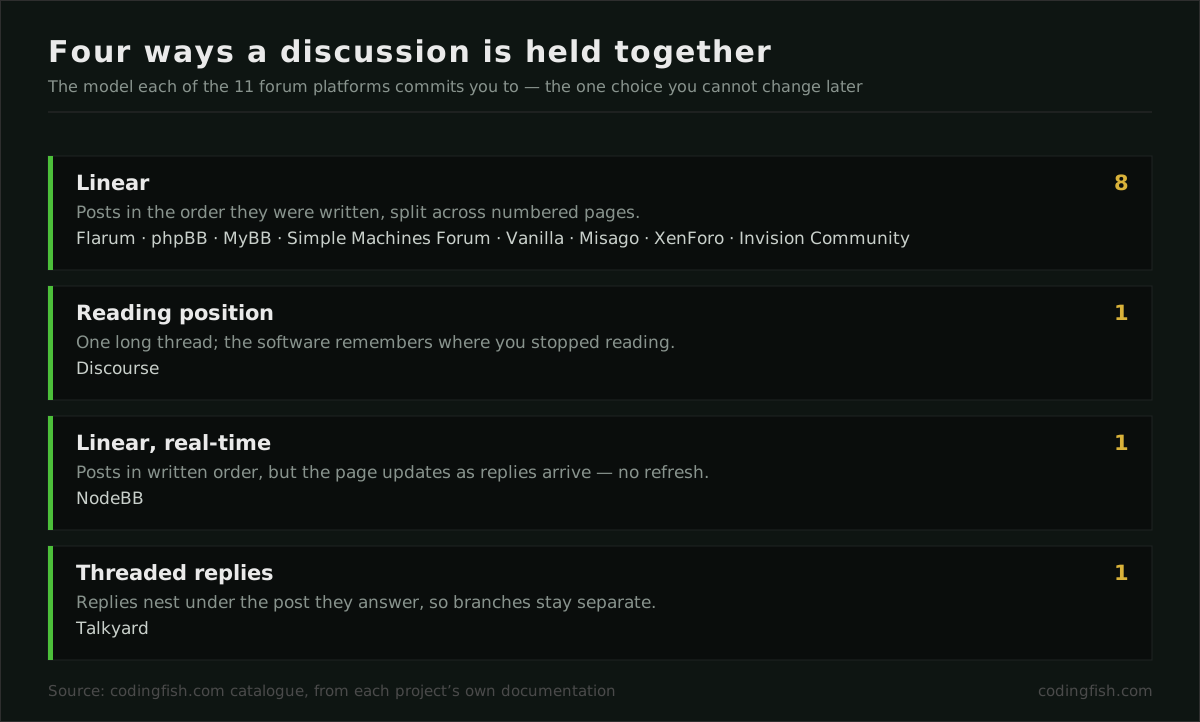
Thread model: the choice self-hosted discussion forum software makes for you
Almost every board here is linear: a topic is a list of replies in the order they were posted, and you page through it. Linear is unglamorous and it has one enormous virtue — the conversation has an obvious end, so returning readers know exactly where to resume and newcomers can read it as a document.
Discourse replaced paging with a reading position and a progress indicator, which turns a hundred-reply thread into something closer to a scrolled article than a stack of pages. On a busy community that is a real improvement. On a quiet one it can read as strange, because the machinery implies a volume of activity that is not there.
Talkyard threads replies properly — a reply attaches to the post it answers, so a disagreement branches instead of interleaving. Threading is better for argument and worse for narrative, and communities that adopt it usually do so because their conversations kept turning into two conversations sharing a page.
NodeBB adds real time to a linear board: replies appear without a refresh. Whether that is a feature depends on the room. It suits an active support forum and it makes a slow board feel emptier, because now you can watch nothing happening.
Thread model and extension mechanism
How each platform structures a topic, and how you add to it.
| Platform | Thread model | Extensions | Runtime |
|---|---|---|---|
| Discourse | Reading position | Plugins and themes (Ruby) | Ruby on Rails |
| Flarum | Linear | Extensions via Composer | PHP (Laravel) |
| NodeBB | Linear, real-time | Plugins and themes (Node.js) | Node.js |
| phpBB | Linear | Extensions (PHP) | PHP |
| MyBB | Linear | Plugins and themes (PHP) | PHP |
| Simple Machines Forum | Linear | Package manager modifications | PHP |
| Vanilla | Linear | Addons (PHP) | PHP |
| Misago | Linear | Django applications | Python (Django) |
| XenForo | Linear | Add-ons (PHP) | PHP |
| Invision Community | Linear | Applications and plugins | PHP |
| Talkyard | Threaded replies | Limited | Scala |
Extensions, and what open source discussion software really lets you change
Every board on that list can be extended, and every extension is a promise that somebody keeps maintaining it against the next major release. The mechanism determines how painful the broken promise is.
Flarum installs extensions through Composer, which means dependency resolution behaves the way the rest of the PHP world behaves: versions are declared, conflicts surface at install time rather than at runtime, and an extension that has not been updated for the current release refuses to install instead of half-working. That is a genuinely better failure mode than the alternative.
Simple Machines uses a package manager that applies modifications to source files. It is flexible and it accumulates: after a few years the installation has drifted from the release it claims to be, and the upgrade that was routine becomes an afternoon of conflict resolution. Boards die this way far more often than they die of a security hole.
Discourse plugins are Ruby and run inside the application; NodeBB plugins are Node modules with hooks. Both projects move quickly, which cuts in two directions — plugins get fixed, and plugins get broken, and the ones maintained by a single person track the second more reliably than the first.
A useful rule when evaluating: look at the extension you would actually need, find its repository, and look at the date of the last commit against the platform's last release. That one comparison predicts more of your future than any feature list on the platform's own site.
Moderation is the product, whatever the marketing says
Every community that survives long enough acquires the same problems: spam signups, one member who cannot let an argument end, and a slow drift in what the room considers normal. Software cannot fix the third. It can make the first two survivable or exhausting.
The tools that matter are unglamorous. An approval queue for first posts stops drive-by spam without blocking genuine newcomers. Rate limits stop a single angry evening from producing forty replies. Trust levels — privileges that unlock as someone participates — let the community absorb newcomers without a moderator approving every action, which is the mechanism that actually scales.
Discourse built trust levels into the core, and a good deal of its reputation rests on that rather than on the reading position everyone notices first. The traditional boards handle the same ground with permission groups, which work but require somebody to configure them thoughtfully once and revisit them occasionally. The failure case is universal: moderation settings are relaxed during the quiet early months because they add friction, and nobody tightens them again before the community is large enough to be worth attacking.
Embedded forums: how to add a discussion forum to a website you already have
Sometimes the discussion belongs inside an existing site rather than at a separate address. Three platforms here are built for that rather than retrofitted to it. Vanilla was designed from the start to be embedded in a page you already own. Talkyard runs both as a standalone forum and as an embedded comment system under existing articles. Discourse supports embedding topics as the comment thread of a blog post, which lets one system serve both jobs.
Deciding to add a discussion forum to a website is not the same as deciding which discussion forum software to run, and the two get conflated constantly. The embedded route keeps the reader where they already are; the standalone route builds a place worth arriving at. Most of the open source discussion software here can do either, and doing both badly is the common outcome.
The trade is identity. An embedded discussion that asks visitors to create a second account collects very few replies, so embedding is only worth doing where single sign-on is already solved. If it is not, a dedicated comment server is the cheaper answer and there are three of them in the catalogue.
Public, private, or the awkward middle
A board can be fully open, fully behind a login, or open to read and closed to post. The third is the most common and the least thought about, and it is usually right: the archive stays findable, contributing requires an account, and the spam surface shrinks to the registration form.
Going fully private has a consequence people underestimate. A closed community cannot be found by anyone who is not already in it, so growth has to come entirely from word of mouth, and the answers accumulating inside help nobody outside. That is a legitimate choice for a paying membership or an internal team. It is a poor default for a project that hopes to be discovered.
All eleven platforms support the read-open, post-closed arrangement. What differs is how much leaks in the closed configuration — whether topic titles appear in category listings, whether user profiles stay visible, whether the search index covers restricted areas. Worth checking against your actual requirement rather than assuming, because the defaults vary.
Attachments turn into a storage problem quietly
Text is cheap. Images and files are not, and a community that allows uploads accumulates them at a rate nobody projects at the start. Two years of screenshots in a support forum is a backup problem, a bandwidth line and eventually a decision about what to delete.
The platforms differ in whether attachments live on the local filesystem or can be pushed to object storage. Local is simpler until the first migration or the first disk that fills at three in the morning. If uploads are central to what the community does, checking for object storage support before adopting is considerably cheaper than retrofitting it after.
Getting the content out again
The question to ask of any platform before adopting it is how the content leaves. Not because you plan to migrate, but because the answer reveals how the project thinks about who owns the archive.
A database dump is not an export. It is a copy of an internal schema that only that application understands, and turning it into another platform's schema is the migration work in its entirety. What you want to see is a documented export format, an importer maintained for at least the major competitors, and — this is the part that decides whether the migration costs you anything — a way of preserving the old addresses.
Most of these projects ship importers from phpBB, because phpBB is where so many communities started. Fewer of them say anything about URLs. A forum that has been accumulating answers for a decade has links pointing at specific topic addresses from every place those answers were ever useful, and a migration that renumbers topics silently discards all of it. The migration guide covers what to keep and how.
Notifications decide whether anyone comes back
A discussion platform without working email notifications is a website people visit once. The reply that arrives three days later is the entire mechanism by which a thread becomes a conversation, and it depends on mail that actually gets delivered rather than on a setting that says it was sent.
Every platform here can send mail. Almost none of them can send it reliably from a fresh server without help, because a new host with no sending history lands in spam folders by default. Budget for a transactional mail provider from the start; it is the cheapest part of the installation and the one whose absence is least visible until the community has quietly stopped returning.
Where to start
Name the runtime your team already supports, then install the two or three candidates that match it and post into each one for a week with moderation turned on. The board that feels right when it is empty is usually the one that will feel right at a thousand posts, because what you are testing is the shape of the thing rather than its capacity.
If the runtime question has no answer — nobody on the project maintains servers — the vendor-hosted option for the same software is not a compromise. It is the same platform with somebody else holding the pager.
Questions people actually ask
What is the difference between forum software and a chat server?
A forum owns a conversation over time: a thread opened in 2019 is still addressable and still answering the question that brought someone in from a search result. A chat server is better at everything happening right now and produces the same question again every fortnight, because nothing is designed to be found later. Neither is better; they suit different groups.
Which self-hosted discussion forum software is easiest to run?
The one in a language you already operate. Seven of the eleven forum platforms here run on PHP, which is why phpBB and its contemporaries remain the default answer for a small community — cheap hosting, one database, almost anyone can patch it. Discourse gives a genuinely better reading experience and asks for PostgreSQL, Redis and a container host in return.
Can a discussion forum be embedded in an existing site?
Several of these can run embedded rather than as a destination, which keeps the reader where they already are. It is a different decision from which platform to run, and the two get conflated constantly: the embedded route suits comments under articles, the standalone route builds a place worth arriving at. Doing both badly is the common outcome.
What is a thread model and why does it matter?
It is how the software holds a conversation together, and it is the choice you cannot reverse. Eight of the eleven forum platforms here are linear — posts in the order they were written, split across pages. Discourse tracks a reading position through one long thread instead. Talkyard nests replies under the post they answer. Migrating between two linear boards is uneventful; migrating away from the other two is not.