Open source community software: a self-hosted catalogue and directory
A self-hosted community software list of 28 platforms you can run on your own server, recorded on the fields that decide whether you can actually keep one alive.
Every entry here is software you install and operate yourself. That is the only membership rule. Some of them also sell a hosted version — 12 of the 28 do — and where that is true it is recorded, because it is often the right answer for a project that has no one to keep a server patched.
The fields are deliberately few. Name, category, licence, runtime, hosting model, and a line saying what the thing actually is. There are no version numbers and no prices, because both go stale between one reading and the next, and a catalogue that quietly lies about a version is worse than one that never claimed to know.
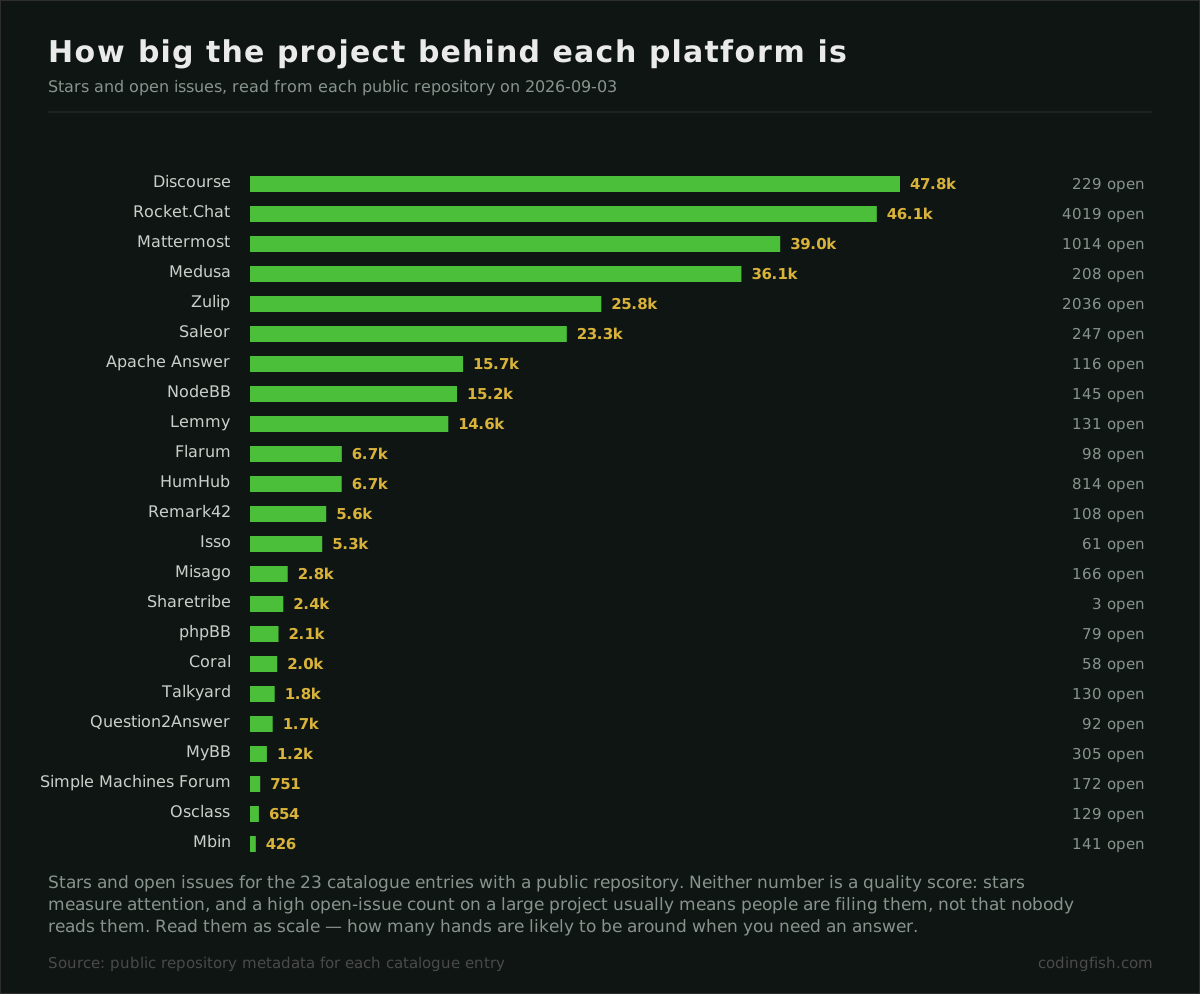
Read the runtime column as a staffing question rather than a technical one, and the licence column as an obligation rather than a price. Those two together eliminate most of this list for any given project, which is what a catalogue is for.
Filter
Every entry, with the licence, runtime and hosting model recorded for each.
| Software | Category | Licence | Runtime | Hosting | Activity |
|---|---|---|---|---|---|
| Discourse Long-thread discussion with a reading-position model rather than pagination. Ships as a Docker image and expects PostgreSQL and Redis. | Forum software | GPL-2.0 | Ruby on Rails | Self-hosted or vendor-hosted | Active 2026-10-24 |
| Flarum Small core with almost everything else as an extension, installed through Composer. | Forum software | MIT | PHP (Laravel) | Self-hosted | Active 2026-10-24 |
| NodeBB Real-time by default over websockets; runs on MongoDB, PostgreSQL or Redis. | Forum software | GPL-3.0 | Node.js | Self-hosted or vendor-hosted | Active 2026-10-24 |
| phpBB The long-running classic. Runs on shared hosting with nothing but PHP and MySQL. | Forum software | GPL-2.0 | PHP | Self-hosted | Active 2026-10-23 |
| MyBB Traditional board layout, template system editable from the admin panel. | Forum software | LGPL-3.0 | PHP | Self-hosted | Active 2026-10-23 |
| Simple Machines Forum Permissive licence and a package manager for modifications. | Forum software | BSD-3-Clause | PHP | Self-hosted | Active 2026-10-24 |
| Vanilla Open-source core alongside a commercial hosted product; embeddable in an existing page. | Forum software | GPL-2.0 (open-source edition) | PHP | Self-hosted or vendor-hosted | Not recorded |
| Misago Django application, which matters if the rest of the stack is already Python. | Forum software | GPL-2.0 | Python (Django) | Self-hosted | Active 2026-10-24 |
| XenForo Paid licence, source supplied. Widely used by large hobby communities. | Forum software | Commercial | PHP | Self-hosted | Not recorded |
| Invision Community Suite rather than a single forum: forums, blogs, galleries and commerce as modules. | Forum software | Commercial | PHP | Self-hosted or vendor-hosted | Not recorded |
| Talkyard Combines a forum with embedded comments for an existing site. | Forum software | AGPL-3.0 | Scala | Self-hosted or vendor-hosted | Steady 2026-07-13 |
| Sharetribe Two-sided marketplace with listings, transactions and reviews built in. | Marketplace software | Apache-2.0 (open-source edition) | Ruby on Rails | Self-hosted or vendor-hosted | Steady 2026-05-11 |
| Osclass Classifieds rather than checkout: listings, categories, contact forms. | Marketplace software | GPL-3.0 | PHP | Self-hosted | Dormant 2022-09-20 |
| Yclas Classifieds script with paid-listing and featured-listing models. | Marketplace software | GPL-3.0 | PHP | Self-hosted or vendor-hosted | Not recorded |
| Cocorico Booking-shaped marketplace: availability calendars and time-based listings. | Marketplace software | MIT | PHP (Symfony) | Self-hosted | Not recorded |
| Medusa Headless commerce core; the storefront is a separate application. | Marketplace software | MIT | Node.js | Self-hosted | Active 2026-10-21 |
| Saleor GraphQL-first commerce platform, also run as a marketplace back end. | Marketplace software | BSD-3-Clause | Python | Self-hosted or vendor-hosted | Active 2026-10-20 |
| HumHub Social network rather than a shop, but frequently used for member directories and listings. | Marketplace software | AGPL-3.0 | PHP (Yii) | Self-hosted or vendor-hosted | Active 2026-10-21 |
| Question2Answer Votes, best answers and tags, on plain PHP and MySQL. | Q&A platforms | GPL-3.0 | PHP | Self-hosted | Dormant 2024-08-20 |
| Apache Answer Single binary, which keeps deployment about as simple as this category gets. | Q&A platforms | Apache-2.0 | Go | Self-hosted | Active 2026-10-21 |
| Mattermost Channel-based chat with an open-source edition and paid tiers above it. | Group chat | MIT and commercial editions | Go | Self-hosted or vendor-hosted | Active 2026-10-21 |
| Rocket.Chat Chat with voice, video and federation options. | Group chat | MIT | Node.js | Self-hosted or vendor-hosted | Active 2026-10-21 |
| Zulip Topic threading inside channels, which reads much closer to a forum than most chat does. | Group chat | Apache-2.0 | Python | Self-hosted or vendor-hosted | Active 2026-10-21 |
| Isso Small comment server for a static site; SQLite storage. | Comment systems | MIT | Python | Self-hosted | Active 2026-09-15 |
| Remark42 Single binary, social logins optional, no external service required. | Comment systems | MIT | Go | Self-hosted | Active 2026-10-20 |
| Coral Built for newsrooms; moderation tooling is the point rather than an add-on. | Comment systems | Apache-2.0 | Node.js | Self-hosted | Active 2026-09-04 |
| Lemmy Link-aggregator shape, federated over ActivityPub. | Federated software | AGPL-3.0 | Rust | Self-hosted | Active 2026-10-21 |
| Mbin Threads and microblog in one instance, federated over ActivityPub. | Federated software | AGPL-3.0 | PHP (Symfony) | Self-hosted | Active 2026-10-20 |
Nothing in the catalogue matches that combination.
More than half the category and runtime pairs have no entry — a Ruby Q&A engine, for instance. Widen one of the filters.
This is a self-hosted community software list rather than a ranking: every entry is open source community software or a commercial product with the source supplied, and each one is here because it can be run on a server you control. The directory covers open source forum and marketplace software together, because the same organisation frequently needs both and the two decisions are usually made by the same person on the same afternoon.
The activity column is the part that goes stale fastest and the part this open source community software catalogue reads directly from each project's public repository. It is not a score. A quiet project may be finished; a busy one may be churning. The date is a prompt to look.
What this open source community software directory leaves out
Hosted-only platforms are absent, however good they are. Open source community software that cannot be run on a server you control does not answer the question this catalogue exists to answer, and adding it would blur the one line that makes the list useful.
So are plugins that add a forum to a content management system. They are a reasonable choice for a site that already runs that system, but they inherit its upgrade cycle and its performance characteristics, and comparing them against standalone platforms produces conclusions that do not hold in either direction.
Projects that have stopped moving are not left out — they are labelled. The activity column reports the last commit to each project's public repository, read at build time, and sorts it into four bands. That is an observation, not a verdict: a small, finished tool can sit untouched for a year and still be the right answer, while a large platform going quiet for the same period usually means something else.
What the label is really for is the question nobody asks until afterwards. Adopting a platform is a commitment measured in years, and software nobody is maintaining is not cheaper — it is a migration you have not scheduled yet. Where the band says Dormant, read it as a prompt to check whether anyone is still answering questions before you commit.
Filtering the self-hosted catalogue
The two that narrow hardest are runtime and hosting. Start with runtime: pick the language your team already operates and the list usually drops to a handful. If nothing in that filter looks right, the honest conclusion is often that the hosting filter should be set to the vendor option instead, because the constraint is people rather than software.
The filters exist because a self-hosted community software list is only useful when it is short. Narrowing by category and runtime turns twenty-eight entries into three or four, which is a shortlist rather than a directory. Anything the filters cannot express — moderation tooling, upgrade record, how a project answers a bug report — is in the comparison pages instead, where open source forum and marketplace software gets argued about rather than listed.
Licence is worth filtering when a specific obligation matters — a commercial renewal that has to be budgeted, or an AGPL condition that affects what an employer can keep private. Filtering on it before either of those is a real constraint tends to remove good options for no reason.
Questions people actually ask
What qualifies for inclusion in this catalogue?
The software has to be runnable on a server you control. That is the whole rule, and it is why hosted-only platforms are absent however good they are. Two entries are sold commercially with the source supplied, which still satisfies it; a product you can only rent does not.
What does the activity column mean?
The last commit to that project's public repository, read at build time. It is not a quality score. A small, finished tool can sit untouched for a year and still be the right answer, and a busy repository may be churning rather than progressing. Read it as a prompt to go and look at the project yourself.
Why do some entries have no activity date?
Five of the twenty-eight have no public repository — two are sold rather than downloaded, the rest develop somewhere not visible. Those rows are left blank rather than guessed. For them the health signal is commercial: how long the vendor has been selling, what the support terms say, and whether there is an export path you have actually tested.
Can the list be filtered down to a shortlist?
Yes — by category and by runtime, which are the two constraints that eliminate the most. Twenty-eight entries usually become three or four, which is short enough to install all of them. What the filters cannot express — moderation tooling, upgrade record, how a project answers a bug report — is what the comparison pages are for.