Mattermost vs Rocket.Chat
Both replace a hosted chat service with one you run. They differ less in what they do than in where the free edition stops, and that line is the whole comparison.
Mattermost against Rocket.Chat
The fields both entries record, with the rows they disagree on marked.
| Criterion | Mattermost | Rocket.Chat |
|---|---|---|
| Runtime | Go | Node.js |
| Licence | MIT and commercial editions | MIT |
| Hosting | Self-hosted or vendor-hosted | Self-hosted or vendor-hosted |
| Activity | Active2026-10-21 | Active2026-10-21 |
Channels, threads, direct messages, file sharing, search, integrations, mobile and desktop clients, single sign-on — both have all of it, and a feature comparison produces two identical columns. The interesting question is a licensing one, and it is the question that decides whether the deployment stays free.
Where the open edition stops
Both projects are open source with a commercial edition above the free one, and both put the same category of thing behind the paid line: the features an organisation needs once it is large enough for compliance to exist. Granular permissions, retention and export for legal purposes, advanced directory integration, high availability.
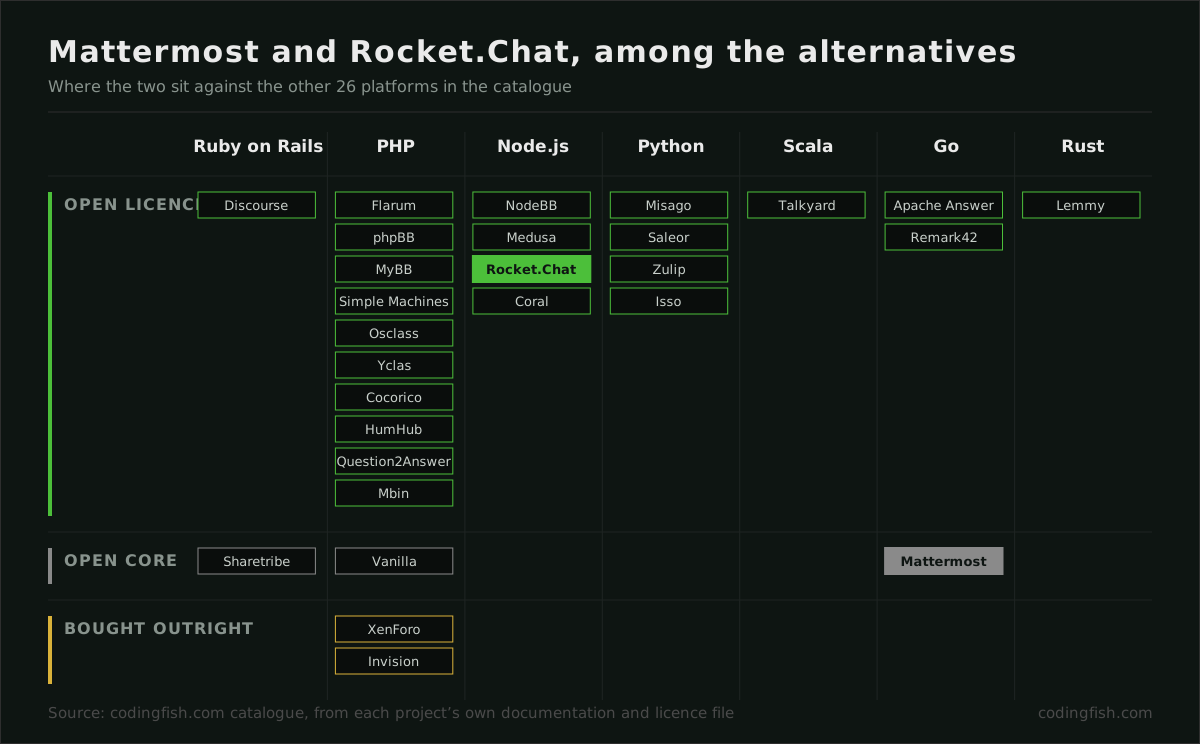
Mattermost has historically been the more explicit about this boundary, which is a virtue rather than a criticism — you can read where the line is before you deploy rather than discovering it during a procurement review. Rocket.Chat's line has moved more over the years, which is worth checking against the current documentation rather than against anything written about it, including this page.
The practical instruction is the same for both: write down the three capabilities you would need at twice your current size, then confirm which edition contains them. Doing that before the migration costs an hour; doing it afterwards costs the migration.
What each one is shaped for
Mattermost is aimed squarely at teams and increasingly at regulated ones. The channel model, the integrations and the tone of the product all assume an organisation with a boundary — an internal tool, not a public space. That focus shows in how coherent the core experience is.
Rocket.Chat covers more ground. It carries omnichannel features for talking to customers, a livechat widget for a website, federation, voice and video — capabilities Mattermost either leaves to integrations or does not attempt. If chat is a channel to people outside the organisation, that breadth is the reason to choose it.
The trade is the usual one. Broader scope means more surface to configure, more to keep updated, and more places for a release to change something you were relying on.
Running them
Mattermost is a Go binary with PostgreSQL behind it, which makes deployment about as undramatic as this category gets: one process, one database, a reverse proxy in front. Upgrades replace the binary.
Rocket.Chat is a Node.js application on MongoDB. That is entirely workable and it is more moving parts, and the MongoDB version requirement in particular is the thing most likely to complicate an upgrade — it has a history of needing attention rather than being incidental.
For a small team without dedicated operations staff, the Go binary is meaningfully less to think about. That is not an argument about which is better software; it is an argument about which one you will still be patching next year.
Threads, and whether either is the right tool at all
Both added threaded replies to channels, and both do it as a secondary structure rather than the primary one. Chat is chat: the channel scrolls, and a thread is a way to keep one conversation from flooding it.
That distinction matters more than the comparison between them. If the goal is answers that somebody finds two years later from a search result, neither of these is the right shape — they will produce the same question every fortnight and forget it each time. Zulip is worth a look precisely here, because it threads topics inside channels as the primary model and ends up closer to a forum than most chat is.
And if the archive is genuinely the point, a forum is the honest answer and this page is the wrong comparison. Working out which shape you need is what the picker asks first.
Search, and why it decays faster here
Chat accumulates volume that a forum never approaches — a busy channel produces more messages in a month than a small board produces in a year — and almost all of it is worthless. Search has to find the one useful message in that, which is a harder job than finding a topic.
Both handle it acceptably out of the box and both support connecting an external search engine for large installations. If the deployment will grow, plan for that rather than assuming the default scales, because the point at which people stop trusting search is the point at which they start asking the question again instead.
Retention policy interacts with this directly and is easy to get backwards. Keeping everything forever makes search worse and storage a line item; discarding aggressively makes the tool feel disposable. Both let you set it per channel, which is the setting worth spending ten minutes on during setup.
Integrations, and the part that breaks
Both have webhooks, slash commands and bot frameworks, and both connect to the things a team expects — version control, issue trackers, monitoring. The catalogues differ in size and neither is short.
What differs is maintenance. An integration written against a hosted chat product has one vendor keeping it working; a community-maintained integration for a self-hosted server has whoever wrote it. Before adopting either platform for a workflow that depends on a specific integration, look at that integration's repository and its last commit — the same check that decides every extension question on this site.
Clients, which is where users form an opinion
Both ship desktop and mobile clients for the usual platforms, and both work. Mattermost's are generally regarded as the steadier of the two, which follows from a narrower product with fewer features to expose in the interface.
Rocket.Chat's clients carry more, including the voice and video features, and inevitably have more to go wrong. If mobile use will be heavy, install both on a real phone during the trial — the difference shows up in daily use and not in a specification.
What each costs before anyone pays a licence
Chat is heavier to run than a forum, and the reason is that it is always connected. A board serves a page and forgets you; a chat server holds an open connection to every client and pushes to all of them, which turns idle users into ongoing cost.
In practice both want their own server with a few gigabytes of memory for a small team, and both grow with the number of connected clients rather than with the volume of messages. That is the opposite of the intuition most people bring from forums, and it is why a fifty-person chat server can need more machine than a fifty-thousand-post board.
Mattermost's single Go binary is the lighter of the two at rest. Rocket.Chat with MongoDB carries more baseline, and MongoDB in particular is the component most likely to want attention as the deployment grows.
Federation, which only one of them treats as a goal
Rocket.Chat supports connecting servers to each other, so people on separate instances can talk without either side creating an account on the other. For an organisation that works across boundaries — partners, contractors, a wider community — that is a genuine capability rather than a checkbox.
Mattermost approaches the same need through shared channels in its commercial editions, which is a different shape: connected instances under an agreement rather than open federation.
Whether either matters depends entirely on whether the boundary of the organisation is also the boundary of the conversation. If it is, federation is complexity you are not using. If it is not, it is the row that decides this comparison, and it decides it for Rocket.Chat.
Migrating from a hosted service
Most people arrive at these from a hosted chat product, and both provide import paths from the common ones. What survives is worth confirming: messages and channels usually, files sometimes, and threading often flattened.
Chat history is also the case where losing some of it matters least — the value of a scrolling channel is mostly in the last few weeks, which is the argument for chat and against it at the same time. If the archive is what you are protecting, see the paragraph above about shape.
Guests, and who can be let in
A chat server that only staff can use is a simpler thing than one outsiders join, and both products handle the second case differently enough to matter.
Both support guest accounts with restricted access to particular channels, and in both the more granular controls tend to sit above the free line. If contractors, clients or community members will be in here alongside employees, that is one of the three capabilities worth confirming against today's documentation before deploying.
It is also worth deciding what a guest sees of the history in a channel they join. Both can be configured either way, and the default is not the same as the decision — a guest reading two years of internal conversation is a surprise nobody wants to discover afterwards.
Deciding
Take Mattermost if this is an internal tool, if you want the smallest thing to operate, or if you can see a future in which compliance requirements arrive and you want the boundary written down in advance.
Take Rocket.Chat if chat needs to reach people outside the organisation — customer conversations, a widget on the site, federation with other servers — and the extra surface is buying something you will actually use.
And check the edition boundary against today's documentation before either. It is the only row on this page that changes without warning, and it is the one that determines what the deployment costs a year from now.
Questions people actually ask
What decides between these two?
Where the open edition stops. Both replace a hosted chat service with one you run, and they differ less in what they do than in which features sit behind the paid tier. Establish which of those features you will actually need before comparing anything else.
Are they open source?
Both are, with a qualification worth stating plainly. Rocket.Chat ships under an open licence; Mattermost is open core, with a real free edition and paid tiers above it. That is not a criticism — it is a licensing shape, and it decides which features you can rely on without a contract.
Can either replace a forum?
Not really, and the reason is structural. A channel that scrolls produces the same question every fortnight because nothing is designed to be found later. If the community's value is an archive that answers search queries, chat is the wrong shape however good the software is.
What do they ask of the server?
More than a PHP board and less than people expect. Mattermost is a Go binary with a database; Rocket.Chat is a Node application with MongoDB. Both want a process kept alive and a websocket path through whatever sits in front of them, which is the operational difference from a request-response forum.