XenForo vs Invision Community
Both are bought rather than downloaded, both are mature, and the technical distance between them is smaller than the distance between what each one is trying to be.
XenForo against Invision Community
The fields both entries record, with the rows they disagree on marked.
| Criterion | XenForo | Invision Community |
|---|---|---|
| Runtime | PHP | PHP |
| Licence | Commercial | Commercial |
| Hosting | Self-hosted | Self-hosted or vendor-hosted |
| Thread model | Linear | Linear |
| Extensions | Add-ons (PHP) | Applications and plugins |
| Activity | Not recorded | Not recorded |
Everything else in this catalogue is open source. These two are not, and the first question is not which of them to buy but whether to buy at all — so it is worth answering that before the comparison.
What a licence purchases is not features. It is a vendor: somebody whose job includes fixing what breaks, shipping security patches on a schedule, and answering a ticket. Communities that outgrew a free board and wanted a number to call have been making that trade for twenty years, and it is a rational one whenever the board matters more than the line item.
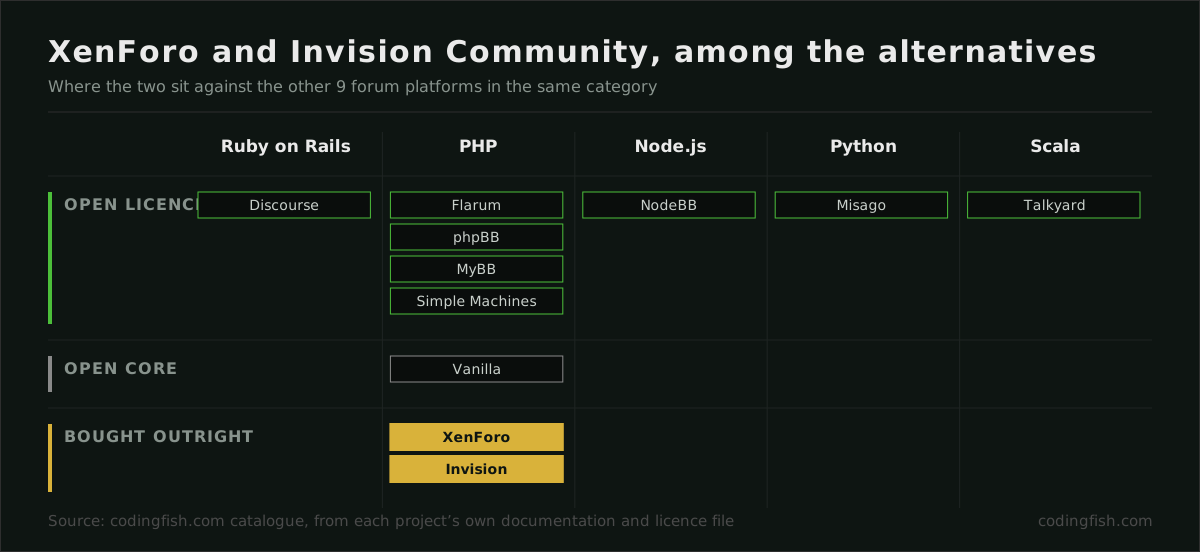
The row that decides it
XenForo sells a forum. Invision Community sells a suite — forums plus blogs, galleries, downloads, calendars, pages and a commerce layer, each licensed as a module.
That is the whole comparison, restated: if the requirement is a forum, the suite is surface area you will pay for and not use, and every unused module is another thing that has to be kept updated and secured. If the requirement is a members' area where the forum is one part among several, assembling that from a forum plus extensions is more work and less coherent than buying it built.
Almost every other difference on this page follows from that one.
What the money buys, concretely
Both are sold as a licence with a renewal that keeps you receiving updates and support. Let the renewal lapse and the software keeps running — you simply stop getting patches, which for public-facing forum software is a slow-motion problem rather than an immediate one.
Invision's modular pricing means the figure depends on which parts you take, and it grows as you add them. XenForo's is simpler: the forum, plus a small number of official add-ons if you want them. For a straightforward board XenForo is usually the cheaper commitment; for a site that would otherwise buy or build four separate things, Invision frequently is not.
Both also sell hosting for their own software. That is worth pricing honestly rather than dismissing, because it removes the failure mode where the person who understood the deployment moves on — and on a commercial licence you are already paying for a relationship.
Add-ons, and the market around each
Both have real commercial marketplaces, which is a genuine difference from the open-source side of this catalogue: an add-on you pay for has somebody with an incentive to keep it working through the next major release.
XenForo's third-party market is the more active of the two by reputation, and its add-ons tend to be forum-shaped, because that is what the platform is. Invision's ecosystem is smaller and spread across the modules, which is the arithmetic consequence of covering more ground with fewer developers.
The check is the same one that applies everywhere: identify the add-on you would actually need, and look at whether it has been updated against the platform's current release. A paid add-on that stopped being maintained is not better than a free one that did.
Where they are genuinely alike
Both run on PHP and MySQL, so the hosting question is the same and neither imposes an unusual operational burden. Both ship the source with the licence, so a developer can read and modify what they run — this is not open source, but it is not a black box either.
Both have mature moderation tooling, permission systems built for large boards, and interfaces that assume real volume. Both handle a busy community without complaint. If the shortlist is down to these two, the board will work either way, and the decision is about fit rather than capability.
The activity column is empty here, and that is the point
Everywhere else on this site the table reports the last commit to a project's public repository. For these two it says nothing, because there is no public repository to read — the source ships to licence holders and development happens in private.
That is not a gap in the data; it is the difference between the two models made visible. With an open project you can check the pulse yourself in a minute. With a commercial one you are reading release notes, forum announcements and the vendor's own communication, and you are trusting a company rather than observing a repository.
The substitute check is the release history on each vendor's site: how often a version ships, how quickly security releases follow a disclosure, and whether the gap between major versions is shrinking or growing. It is less direct and it is available to anyone considering the purchase.
Search, and what a licence buys there
Both handle search better than the free PHP boards, which is one of the quieter things the money buys. Both also support connecting an external search engine for large installations, which is the point at which a database-backed search stops being adequate on any platform.
For a board with real history this matters more than any interface difference on this page. A community's value is the answers buried in it, and if members cannot retrieve them the archive is storage rather than an asset. Worth testing with a realistic amount of content during the trial rather than discovering at year three.
What you give up by paying
Two things, and they are worth naming because the commercial comparison usually omits them.
The first is the exit. Discourse ships maintained importers for both — XenForo and Invision are among the sixty-three sources in its importer directory — so leaving for an open platform is a real path. The reverse is thinner, and moving between the two commercial products is thinner still.
The second is that you are now dependent on a company's continued interest in a product category that has been shrinking for a decade. Both vendors have long records, and that is the mitigation rather than a guarantee. The practical version is to confirm that a full export can be produced by somebody who is not a database administrator, before you need it.
Who administers it
Both administration panels are built for people who run a board as part of their job, and both are correspondingly dense. That density is a feature at scale and an obstacle for a volunteer who logs in once a fortnight.
Invision has more of it, because there is more to configure: every module brings its own settings, permissions and moderation surface. XenForo's panel covers one product and is proportionally easier to hold in your head. If the person administering this is not doing it full time, that difference is worth more than it sounds.
Both vendors let you run the software before buying. Spend an afternoon in each panel with a real task in mind — create a private section, set up a moderator group, configure the registration flow — rather than clicking around. The one that makes those three things obvious is the one somebody will still be maintaining in three years.
Migrating in, which both do well
Both vendors have a commercial interest in making it easy to arrive, and both provide importers from the common free boards. That is genuinely useful and it is the direction with the most attention behind it.
The caution is the same as everywhere: an importer that carries posts and users is not the same as one that preserves addresses. A board that has been accumulating answers for years has links pointing at specific topic addresses, and a renumbering import discards them silently unless the mapping is captured while the source database still exists. The procedure is in the migration guide, and it applies identically whether the destination is paid or free.
When neither is the answer
If the board will be quiet, a commercial licence buys support for a problem you will not have. A traditional open board runs on the hosting you already pay for, and the renewal you did not take is the cheapest support contract there is.
If the community is busy and technically staffed, Discourse gives away a great deal of what the licence would have bought — moderation tooling designed for volume, a reading model built for long topics — in exchange for running PostgreSQL and Redis. That trade is covered in the Discourse comparison.
The case for paying is strongest in between: a board large enough that failures cost something, without staff whose job is keeping it running.
Deciding
Take XenForo if you want a forum, want it to be excellent at being a forum, and would rather not pay for parts you will not switch on.
Take Invision Community if the forum is one component of a members' area that also needs galleries, downloads, a calendar or commerce — and price the modules you actually need rather than the entry figure.
Try both before committing. Each vendor offers a way to run the software before buying, and an afternoon in each administration panel settles a question that no comparison page can. That is particularly true here, where the software is close enough that preference is a legitimate tiebreaker rather than an evasion.
Questions people actually ask
Why compare two paid boards at all?
Because communities genuinely weigh them against each other, and because both are still in business twenty years into a field full of free alternatives. What the fee buys is an upgrade path and part of the operational burden — a trade that is frequently cheaper than the hours it removes.
What is the actual difference?
One sells a forum, the other sells a suite. XenForo is a board with extensions around it; Invision Community bundles a forum with a set of other applications and expects you to want them. You pay for the difference either way, so the question is whether you will use the rest.
Do you get the source code?
Yes, with both. A commercial licence here is a purchase rather than a rental, and the source is supplied — which is why they qualify for a catalogue whose membership rule is that the software runs on a server you control.
Can content move off them later?
Discourse maintains importers for both, so the exit exists and is documented. That is a genuine part of the value: a paid platform without an export path is a much larger commitment than a paid platform with one.